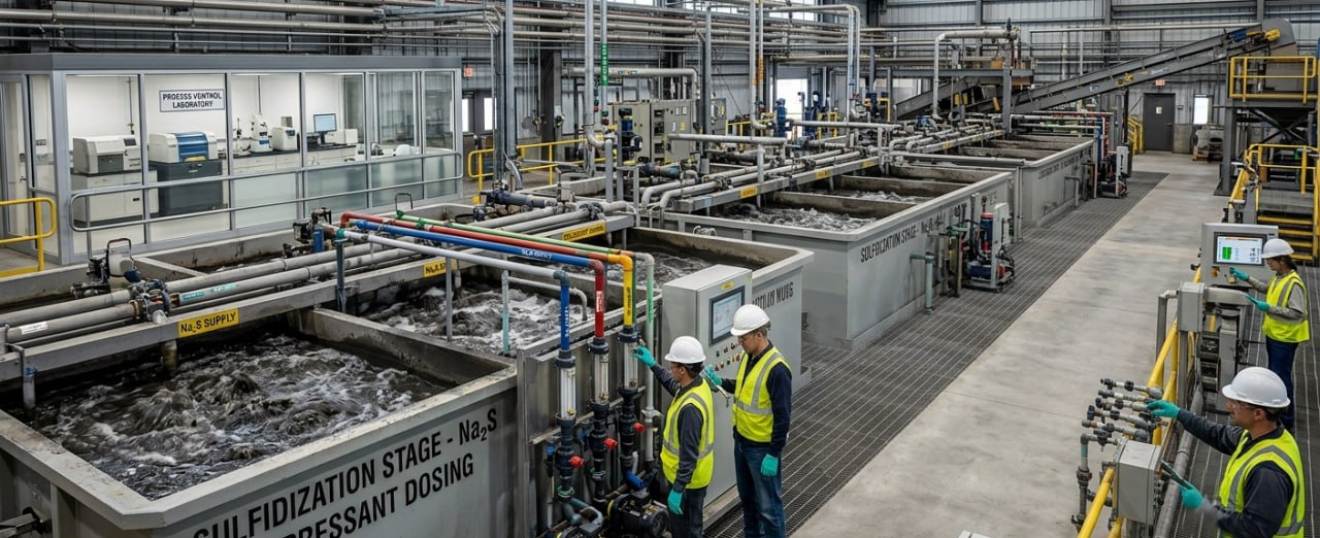
In industrial mineral processing, chemical manufacturing, and wastewater treatment, filtration is rarely just a mechanical operation. It is a complex physical-chemical process. Efficiency in solid-liquid separation measured by throughput, filtrate clarity, and, most importantly, filter cake moisture content is dictated by the chemical conditioning of the feed stream long before it reaches the filter press or vacuum belt.
For plant operators, poor dewatering isn’t just a technical nuisance; it is a financial drain. Wet, sloppy filter cakes increase transportation weight, inflate landfill disposal fees, and signify incomplete process recovery. This guide explores how precision chemical conditioning optimizes dewatering performance and maximizes your facility’s output.
The Physics of the Filter Cake: Why Conditioning Matters
A filter cake is essentially a porous media that must allow liquid to pass while retaining solids. If fine particles are allowed to randomly pack, they create a dense, blinding layer that traps water and blocks hydraulic flow paths.
Chemical conditioning aims to fundamentally alter the particle morphology by:
Neutralizing Surface Charges: Utilizing coagulants to destabilize repulsive negative charges on fine particles.
Flocculation (Bridging): Utilizing high-molecular-weight polymers to bridge small particles into larger, robust flocs.
Increasing Porosity: Creating structured flocs that are resistant to mechanical shear, allowing water to channel through the cake easily rather than being trapped in microscopic interstitial spaces.
Key Mechanisms: Coagulation vs. Flocculation
Achieving the “perfect” cake structure requires a two-stage approach in chemical dosing:
A. Coagulation (The Destabilization Phase)
Particles in industrial suspensions are typically negatively charged, causing them to repel each other and remain suspended. Inorganic coagulants such as Aluminum Sulfate, Ferric Chloride, or Polyaluminum Chloride (PAC) neutralize these surface charges. This allows the particles to collide and aggregate at a micro-level.
B. Flocculation (The Aggregation Phase)
Once destabilized, particles need to be gathered into large, settleable flocs. This is where long-chain organic polymers (polyacrylamides) are introduced. These polymers act as a molecular anchor, binding micro-flocs into macro-flocs.
Crucial Insight: The physical strength of these flocs determines if they survive the pump shear and filter press pressure. Weak flocs break apart, releasing fines that clog the filter cloth and seal the cake.
The Business Case for Improved Dewatering
Why should operations management prioritize chemical conditioning optimization?
Lowered Disposal Costs: A 5-10% reduction in filter cake moisture can translate to massive savings in waste transportation and tipping fees, particularly for large-scale mining and chemical operations.
Increased Throughput: With a more porous, structured cake, cycle times on filter presses are reduced. The equipment can process more batches per shift without upgrading mechanical capacity.
Improved Filtrate Quality: Properly conditioned flocs trap fine solids effectively, resulting in clearer filtrate water that can often be recycled back into the process, reducing raw water intake costs.
Extended Media Life: Preventing blinding (where fines clog the filter fabric) reduces the frequency of manual cleanings and cloth replacements, directly extending the lifespan of industrial filter components.
Industrial Chemical Supply for Separation Processes
Consistency is the enemy of optimization. If the assay of your coagulants varies by even 2-3%, your entire dosing control logic will fail, leading to inconsistent cake quality and downstream process upsets.
PKS Chemicals provides the high-purity inorganic salts and chemical building blocks required for consistent industrial conditioning programs.
Verified Purity: We supply technical-grade salts with guaranteed assay concentrations to ensure your plant’s dosing formulas never need recalibration due to raw material variability.
Stable Logistics: With reliable supply chains serving Pakistan, Turkey, Iraq, and the CIS region, we ensure your storage silos remain stocked, preventing emergency downtime.
Technical Data Support: Every shipment is accompanied by detailed Technical Data Sheets (TDS) and Safety Data Sheets (SDS), ensuring your team understands the exact chemistry of the conditioning agents being applied.
Maximizing the efficiency of your solid-liquid separation process is a balancing act of physics and chemistry. By transitioning from a one-size-fits-all approach to a structured chemical conditioning program, plants can realize immediate improvements in filter cake dryness, process throughput, and operational overhead.
Are your current filtration cycles limiting your production capacity?
Contact the technical team at PKS Chemicals to discuss your current solid-liquid separation challenges and how our high-purity chemical range can optimize your dewatering performance.