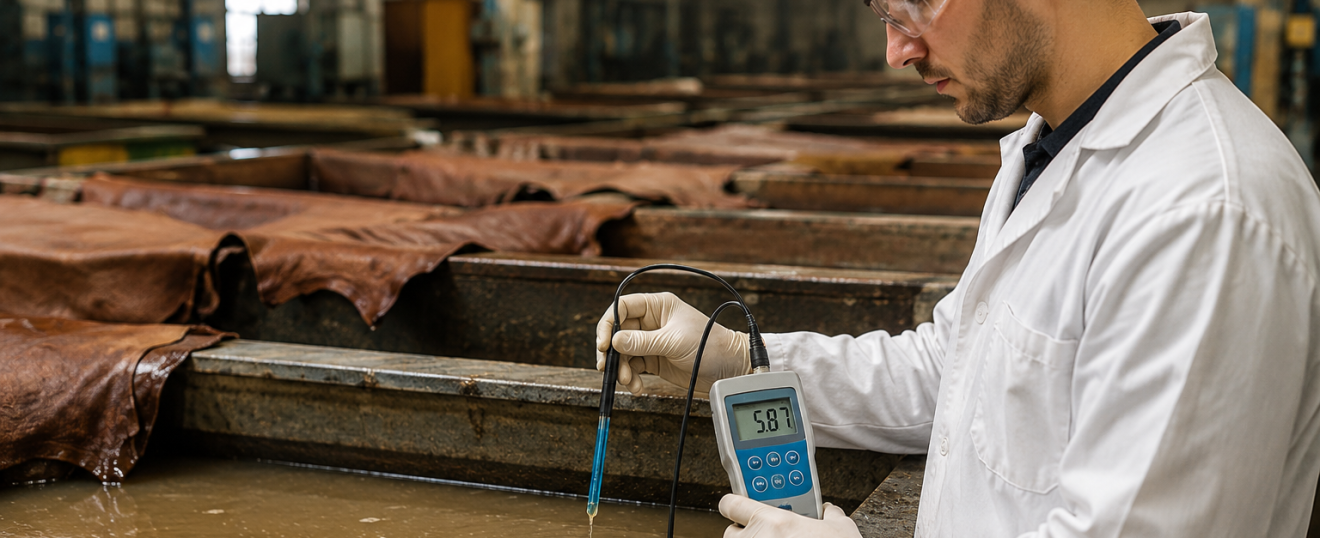
In leather manufacturing, the conversion of raw animal hides into durable, high-quality leather is entirely governed by physical-chemical reactions. Among all operational parameters, pH control is the single most critical variable.
From the initial beamhouse steps to the final finishing stages, the pH of the processing baths dictates the electrical charge of the collagen fibers, the solubility of processing chemicals, and the penetration depth of tanning agents.
Failing to maintain precise pH thresholds not only compromises the physical properties of the leather—resulting in loose grain, stiffness, or dye patchiness—but also increases chemical waste and environmental compliance risks.
This technical guide outlines the role of pH at each major stage of leather processing, the chemical mechanisms of collagen charging, and strategies for stabilizing pH throughout the tanning cycle.
The Isoelectric Point of Collagen and pH Dynamics
To understand why pH is so dominant in leather processing, one must look at the molecular structure of collagen. Collagen is an amphoteric protein, meaning it contains both acidic carboxyl groups and basic amino groups along its polypeptide chains.
The charge of these groups changes depending on the pH of the surrounding float:
In Acidic Mediums (Low pH): Carboxyl groups gain protons and become neutral, while amino groups gain protons and become positively charged. The collagen pelt takes on a net positive charge.
In Alkaline Mediums (High pH): Amino groups lose protons and become neutral, while carboxyl groups lose protons and become negatively charged. The collagen pelt takes on a net negative charge.
3. The Critical Role of pH in Tanning and Basification
The interaction between pH and chemical reaction rates is best demonstrated during chrome tanning:
Penetration Phase (Low pH): Chrome tanning salts (basic chromium sulfate) are added to the drum at a low pH (2.5 to 3.0). At this pH, the carboxyl groups on the collagen fibers are protonated and carry no charge, preventing them from reacting with the chromium complexes. This allows the chromium molecules to diffuse completely into the center of the cross-section of the hide.
Fixation Phase (Basification): Once uniform penetration is achieved, the pH of the float is slowly raised to 3.8−4.2 using a mild basifying agent like magnesium oxide or sodium bicarbonate. As the pH rises, the carboxyl groups deprotonate to carry negative charges, forming strong coordination bonds with the cationic chromium complexes.
If basification is done too quickly, or if the pH rises too high, chromium will precipitate on the surface of the hide, leaving the core untanned and causing a defect known as “drawn grain.”
5. Industrial Chemical Consistency for Tannery Operations
Because leather processing relies on tight pH windows, the purity, concentration, and buffering capacity of your chemical inputs are vital. Inconsistent chemical grades cause unexpected pH spikes or drops, leading to process instability and costly batch rejections.
PKS Chemicals is a reliable B2B supplier of industrial-grade chemical inputs, including Sodium Sulfide, Sodium Carbonate (Soda Ash), and specialized chemicals for tannery operations. We ensure consistent specifications, strict quality control, and secure export logistics to help your plant maintain precise process control.
To access technical data sheets, safety documentation, or specifications, visit our Sodium Sulfide Product Page. (Note: Verify product availability on our main products catalog).
For commercial quotes, technical consultation, or bulk orders, contact our chemical engineers through our Contact Us page.